Overview
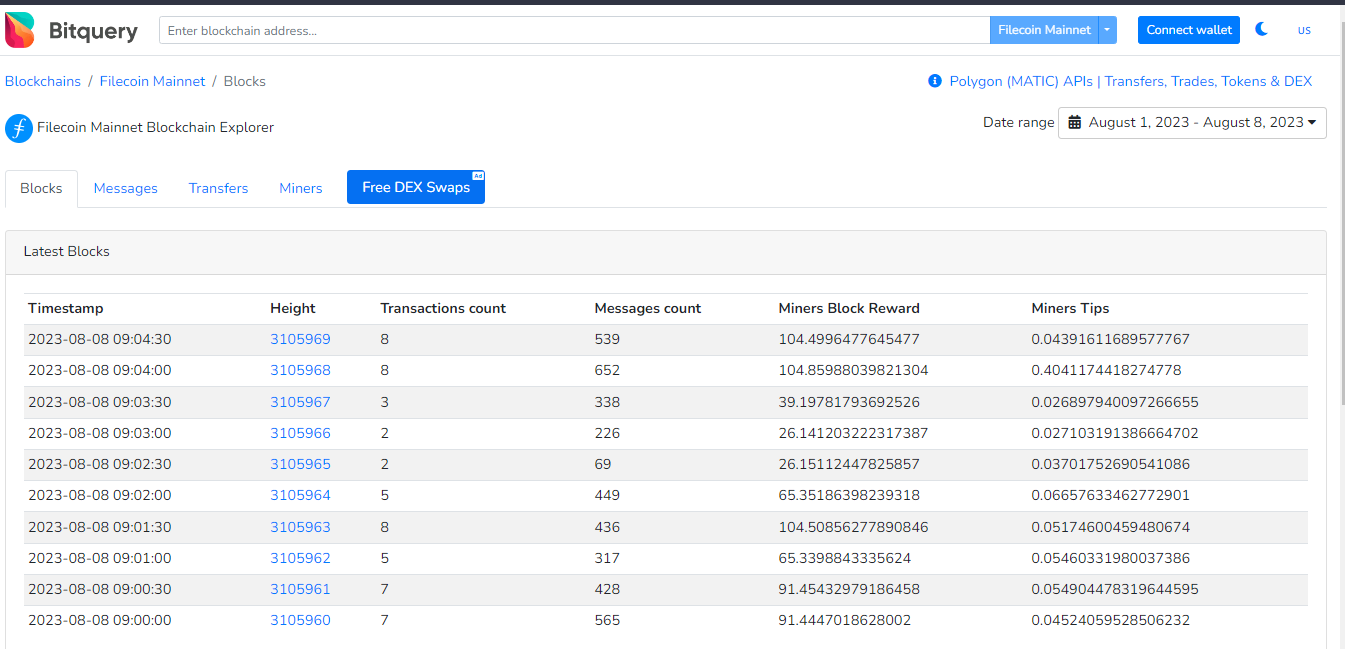
Filecoin is a network built on top of IPFS that allows you store and retrieve data. It uses proof of storage: a miner’s power in the consensus protocol is proportional to the amount of storage it provides. Bitquery's filecoin data includes an explorer for easy-viewing and extensive APIs.
Sign up on our GraphQL IDE and get your Access Token, Read our guide on getting started.
Filecoin is a decentralized storage network: miners earn FIL by committing storage, and the chain records storage deals and proofs rather than a generic “world computer” model. On Filecoin, actors (not EVM-style contracts) implement protocol logic, and the ledger records messages—the primary unit of chain activity—rather than Ethereum-like “transactions” alone. Bitquery exposes this model as blocks, messages, calls, transfers, addresses, and coinpath for tracing flows.
What You Can Query
- Blocks — heights, timestamps, and structural metadata for tipsets and chain progression
- Messages — Filecoin messages with senders, recipients, method names, and execution outcomes where indexed
- Calls — actor method invocations and related execution detail for storage, market, and payment actors
- Transfers — FIL movements between addresses, including fees and value associated with messages
- Addresses — activity and balance-oriented fields for miners, clients, and regular accounts as exposed in the schema
- Coinpath — multi-hop FIL flows for following value through intermediate addresses
Common Use Cases
- Storage economics — relate message and call patterns to deal activity, miner behavior, and network utilization
- Miner and client reporting — summarize transfers and address-level flows for operational or financial reporting
- Forensics — use coinpath to reconstruct how FIL moved across wallets tied to deals or market actors
- Enterprise data compliance — organizations storing regulated data on Filecoin can audit deal lifecycles, storage-provider relationships, and FIL payment flows for procurement and data-residency reporting