Overview
Bitquery's Stellar APIs give you information on the network's blocks, transactions, addresses, operations, payments and so on. To get started, visit the Stellar Explorer
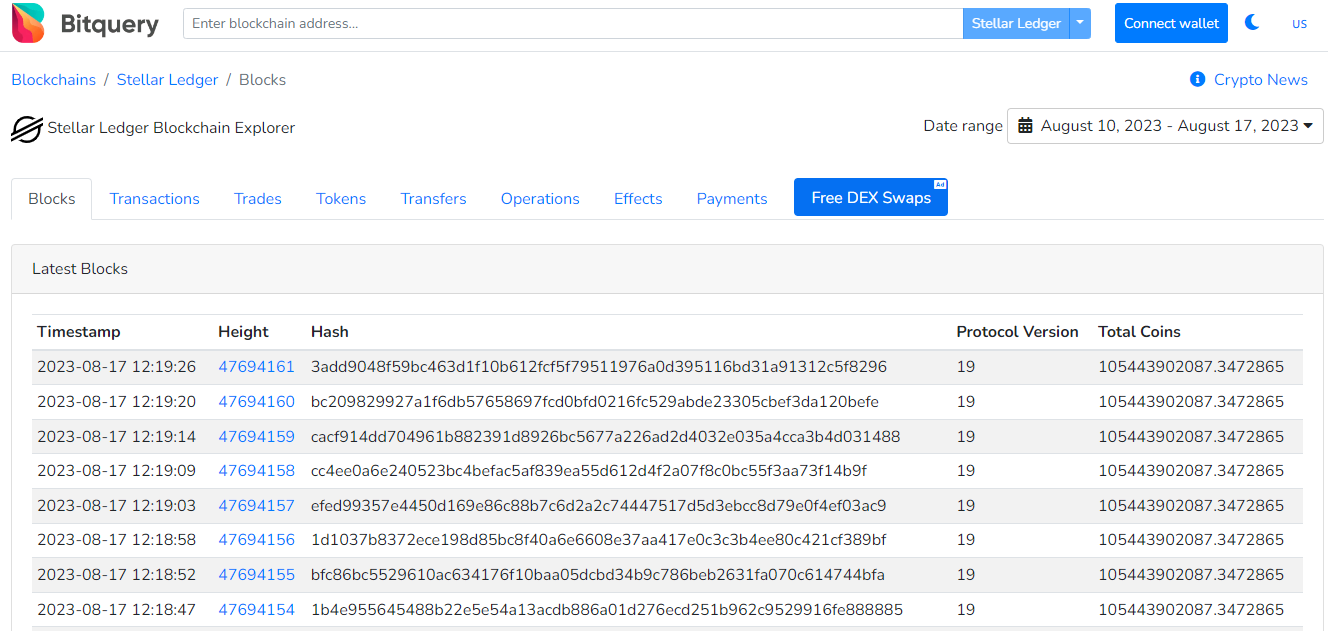
To retrieve data from the Stellar blockchain, you need to use the API as shown below:
query{
  stellar{
    __typename
  }
}
Stellar is a multi-asset ledger: XLM is the native asset, while anchors and issuers define trust lines, tokens, and the on-ledger Stellar DEX. Path payments, liquidity pools, and fine-grained operations and effects model how value moves. Bitquery exposes blocks, ledgers, transactions, operations, payments, effects, transfers, and coinpath for graph-style analysis.
What You Can Query
- Blocks / ledgers — sequence, close times, and summary fields for network progress
- Transactions — hashes, sources, fees, memo fields, and envelopes linking to inner operations
- Operations — payment, path payment, manage buy/sell offer, liquidity pool, and other Stellar operation types
- Payments — payment-specific records with assets, amounts, and destination accounts
- Effects — ledger effects that describe balance and trust-line changes from operations
- Transfers — normalized movements of XLM and issued assets between accounts
- Coinpath — chained flows across accounts and assets for analytics and tracing
Common Use Cases
- SDEX and anchor analytics — volumes, spreads, and offer books for on-ledger markets and issued assets
- Cross-border payment monitoring — path payments, corridor assets, and liquidity pool usage
- Account and asset compliance — reconstruct activity from operations, effects, and transfers
- Enterprise remittance and CBDC pilots — financial institutions and central banks running tokenized fiat or remittance corridors on Stellar can reconcile payment operations, anchor trust-line balances, and settlement flows for regulatory and operational reporting