Ethereum Trace API
Ethereum Trace API examples show how to read EVM execution traces in Bitquery: call order, depth, gas, and nested contract flows in Explorer or GraphQL for debugging, analytics, and security review.
Variations: Reuse the same flow on other EVM networks in Explorer; plug in any transaction hash that returns trace or internal-call data.
What is Ethereum Trace?
Use EVM traces to reconstruct how a transaction actually ran: nested contract calls, gas, return data, and reverts—so you debug failures, compare gas, and audit DeFi or router flows beyond the outer from / to on the receipt.
- Step through internal calls, not only the top-level
to/fromon the receipt. - Inspect gas and errors per sub-call when a batch or router transaction fails partway through.
- Follow control and value flow across nested calls, delegatecalls, and multicall-style routers.
Open trace-oriented queries in the IDE with Call Trace API.
Variations: Filter IDE examples by transaction hash, network, or block range; start from Explorer’s Calls view, then copy the hash into GraphQL when automating.
Follow this transaction in Explorer to see how Call depth maps to EVM execution order in the flat call list.
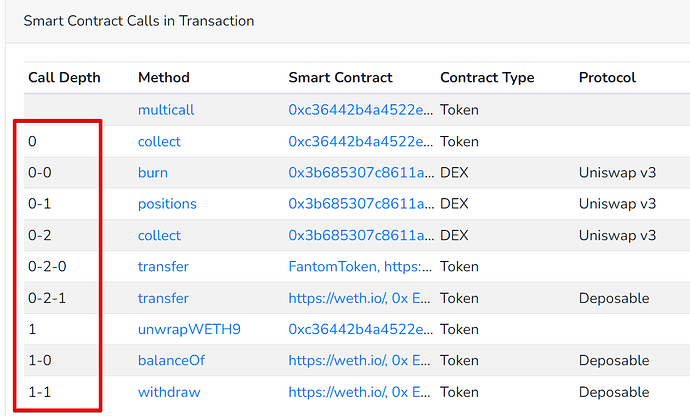
Values like 0 and 0-2-1 encode execution order left to right: outer call → nested call → deeper nested call. Rows match the sequence the EVM executed.
Depth 0-2-1 means: root frame 0, then branch index 2, then 1 at the next level—so you can walk from the root down to that internal call.
Variations: Compare depth strings across Explorer, Bloxy, or your API by anchoring on the same transaction hash; notation lines up once the root call matches.
Decoding the call sequence visually
The same transaction as a tree lets you align Explorer’s flat call list with parent/child relationships in one view.
The call tree looks like the one below.

The pattern is multicall-style: one root fans into multiple contract methods—same contract or several—in a single transaction.
root
root is the top-level call; here it splits into burn and positions.
burn
burn is a leaf in this trace—no deeper nested calls under it.
positions
positions continues into collect as the nested child step.
collect
collect fans into two sibling transfer calls—parallel branches under the same parent.
unwrapWETH9
unwrapWETH9 calls into another contract, nesting balanceOf and withdraw.
Compare the shape on bloxy for an alternate graph layout.
Variations: Open other transactions in Bloxy or Explorer side by side; reuse the hash in GraphQL trace queries when you need the same structure in API responses.
Related Resources
Use these for Ethereum schema reference, Coinpath, the GraphQL IDE, and related API examples.