Overview
Bitquery provides as explorer for you to easily view data on Cardano.
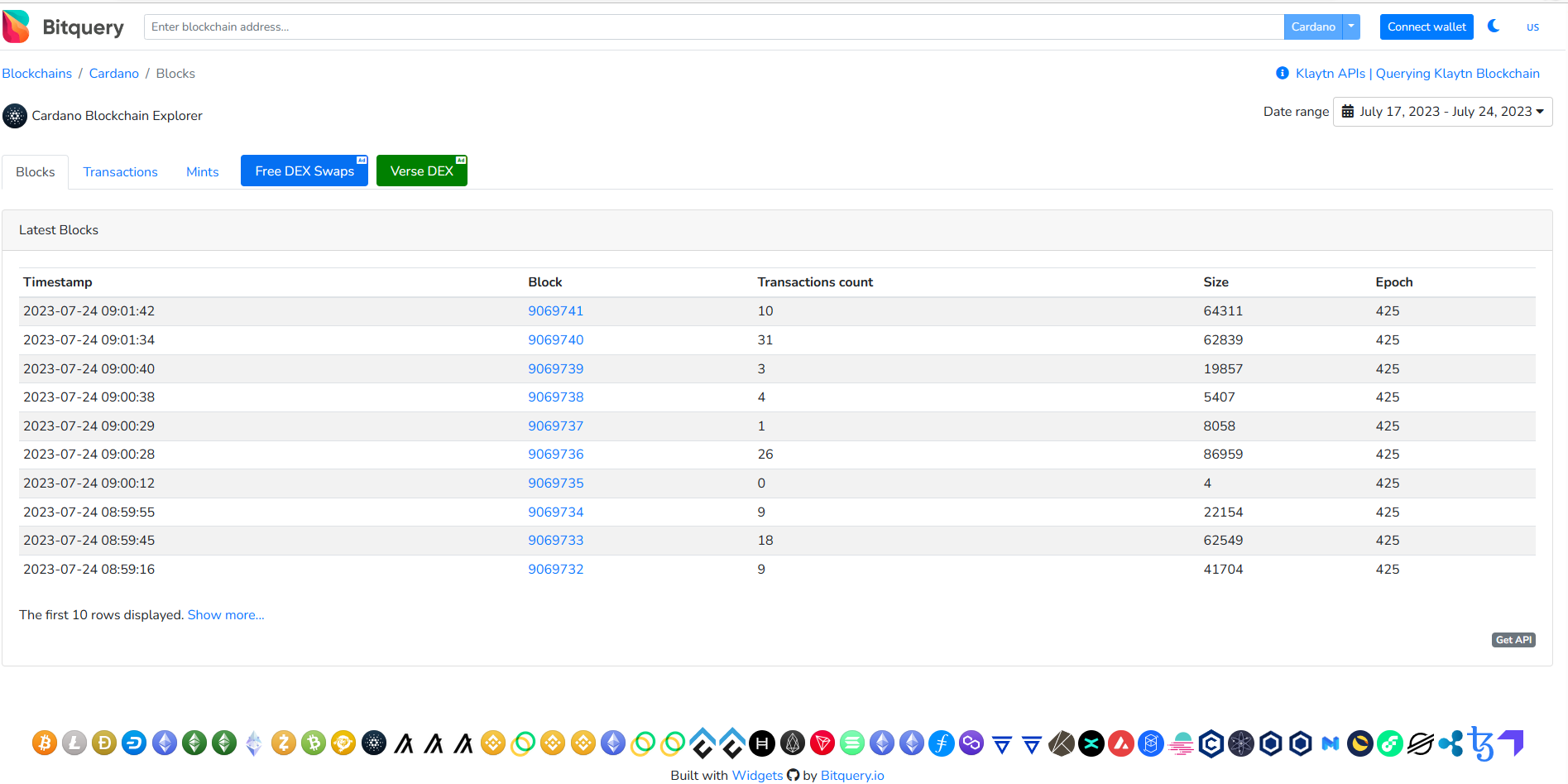
Bitquery API offers access to indexed data from the Cardano blockchain.
to fetch data from Algorand blockchain, you need to provide the network argument with the value cardanoas shown below:
{
  cardano(network: cardano) {
    __typename
  }
}
Let's dive in and explore the cardano data available through Bitquery API.
Cardano uses an eUTXO model: ADA and native tokens live in transaction outputs guarded by scripts; minting policies control token creation. Staking and certificates appear as specialized transaction components. Bitquery indexes blocks, transactions, addresses, transfers, mint events, and coinpath-style flows under the cardano root.
What You Can Query
- Blocks — heights, slot and epoch context, timestamps, and embedded transactions
- Transactions — hashes, fees, metadata, certificates, and withdrawals where present in indexed data
- Addresses — stake and payment address activity derived from outputs and movements
- Transfers — ADA and native asset movements with quantities, policies, and asset names
- Mints — mint and burn events tied to minting policies and transactions
- Coinpath — chained movements across addresses for tracing and analytics
Common Use Cases
- Native asset (token) analytics — issuance, circulation, and holder flows for policy-specific assets
- Staking and delegation views — combine transaction and certificate-related fields for participation metrics (where exposed)
- Wallet and explorer backends — address histories, UTXO/eUTXO-aware transfers, and recent blocks
- Enterprise identity and credentials — organizations issuing verifiable credentials, supply-chain tokens, or governance NFTs on Cardano can monitor minting policies, holder distribution, and lifecycle events through native-asset and transfer queries