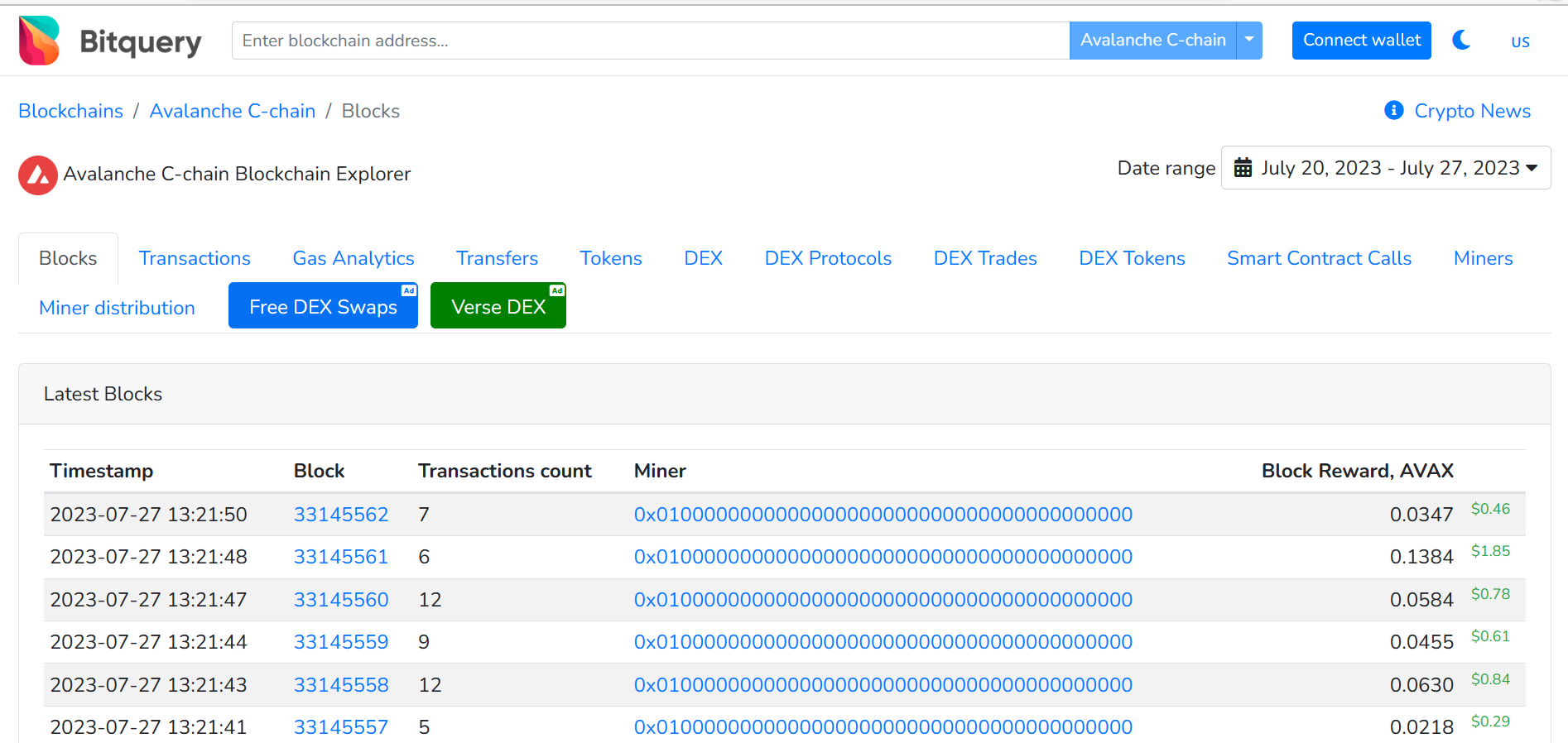
Avalanche is an open-source platform for building dApps that uses its own consensus protocol (Avalanche Consensus). Bitquery offers a Avalanche C-Chain explorer to view Avalanche data easily.
You can use Avalanche APIs by mentioning
ethereum(network: avalanche){

__typename
}
info
Sign up on our GraphQL IDE and get your Access Token, Read our guide on getting started.
Avalanche’s architecture is built around subnets; most developer-facing activity lives on the Contract Chain (C-Chain), which is EVM-compatible, uses AVAX for gas, and hosts major DeFi venues such as Trader Joe and Pangolin. Bitquery indexes this EVM surface so you can query C-Chain blocks, contracts, and token flows alongside other networks.
What You Can Query
- Blocks — heights, timestamps, miner or producer fields, block size, and transaction counts on the C-Chain
- Transactions — hashes, fees paid in AVAX, senders and recipients, finality or status, and gas usage
- Transfers — native AVAX and token movements with amounts, symbols or contract addresses, and USD values where available
- Smart contracts — deployments, calls, and contract-level activity in the same style as other EVM chains
- DEX trades — swap and liquidity events from integrated decentralized exchanges on Avalanche
- Coinpath — multi-hop tracing of how assets moved between addresses across several steps
Common Use Cases
- DeFi analytics — rank pairs, volume, and liquidity events tied to ecosystems such as Trader Joe or Pangolin
- Treasury and wallets — aggregate AVAX and token balances and transfer history for custody or accounting
- Investigations — follow coinpath traces to explain how funds flowed through intermediaries on the C-Chain
- Enterprise subnet and tokenization projects — institutions launching permissioned subnets or tokenized assets on Avalanche can monitor C-Chain contract activity, token flows, and settlement patterns for compliance and operational reporting