Basic Structure of A Query
Bitquery Architecture Let’s understand how we built our infrastructure to enable scalable analytical processing. In the simplest form, we are using Clickhouse (An OLAP database) at our data warehouse and built a GraphQL layer on top of it, and glued them together using a library called Activecube, which we have written from scratch and open-sourced. This library transforms GraphQL queries to Clickhouse queries.
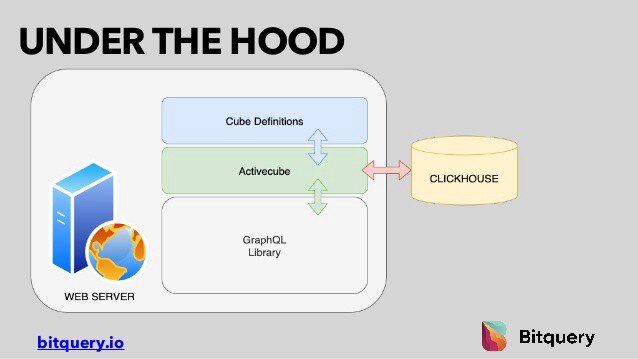
Bitquery architecture
Now, Let’s dig deep and learn how our system works and its capabilities.
Cube
We store blockchain data in cubes. Cube is a shorthand for multidimensional dataset, given that data can have an arbitrary number of dimensions. A cube is not a “cube” in the strict mathematical sense, as all the sides are not necessarily equal. To analyze more complex data, we create hypercubes using multiple cubes.
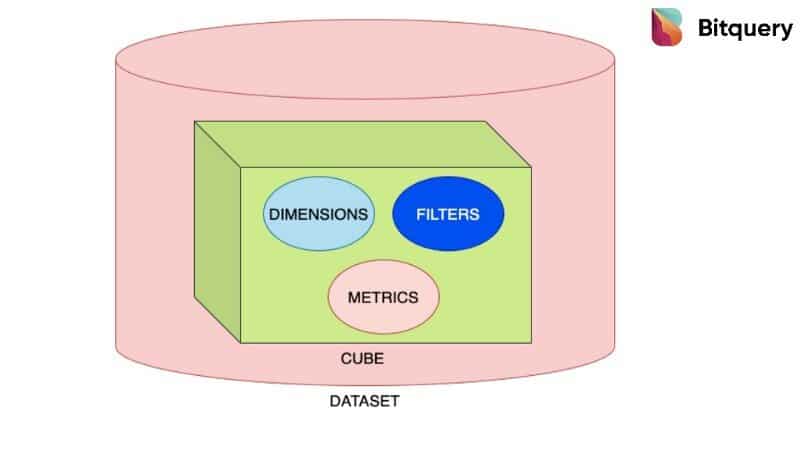
In our case, a typical cube contains dimensions, filters, and metrics. Let me break this down for you.
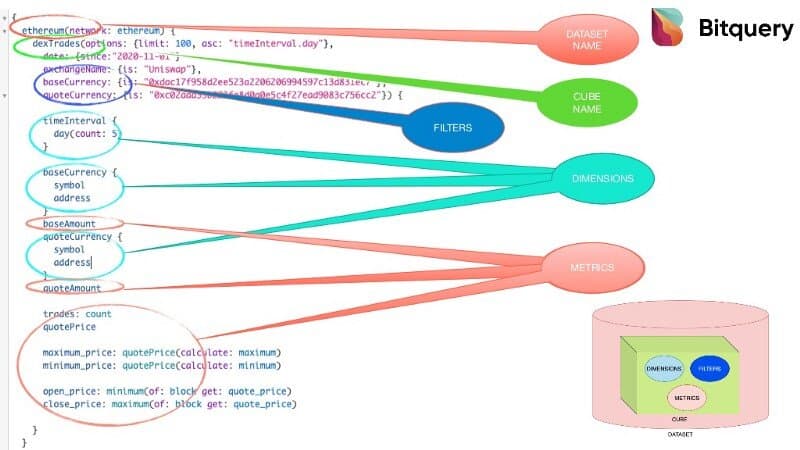
Check out the following GraphQL query, which provides DEX trades for USDT/WETH pair on Uniswap DEX. As you can see, it contains multiple attributes.
- Dataset (Ethereum in this case)
- DexTrades (Cube name)
- Filters (Exchange name, Base currency, Quote currency, etc.)
- Dimensions (Time interval, Base currency, Quote currency)
- Metrics (Base amount, Traders count, Quote price, etc..)
let’s understand them one by one.
Dimensions
Dimensions are defined in the GraphQL schema and have multiple attributes. And Attributes are like sub-dimensions which helps in getting specific data or performing aggregations. Attributes can be multi-level.
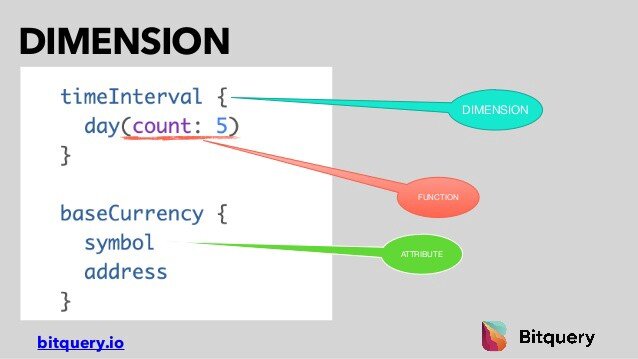
Attributes have functions to enable aggregation. Note, What we call functions, Graphql specifications call them attributes, but we add special meaning to it.
In the above example, day has function count, so it’s helping in aggregating every five days. You can multiple functions enabling different functionality throughout our schema.
So as I said before, functions do not exist on Graphql specification, but we added them to make our queries programmatical, this enhances the capabilities of our queries because we provide a lot of functions and continuously add new functions to enable new functionalities. This is the way we map GraphQL with analytics and add programming capabilities to our queries.
Metrics
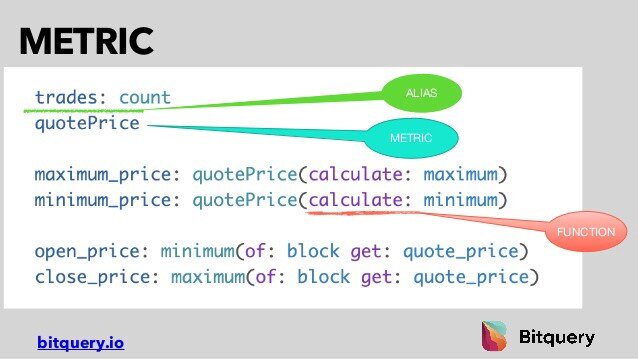
Metrics look similar to Dimensions, however, they behave differently. For example, metrics are usually numerics and they calculate maximum, minimum, and other mathematic functions.
Dataset and Filters
Datasets are types of data such as Ethereum and Binance smart chain, both are Ethereum type datasets because they are similar types of blockchains. Filters help in adding scope and range to queries.