Overview
Bitquery's Ripple APIs give you information on the XRP's blocks, transactions, addresses, offers, payments and so on. To get started, visit the Ripple Explorer
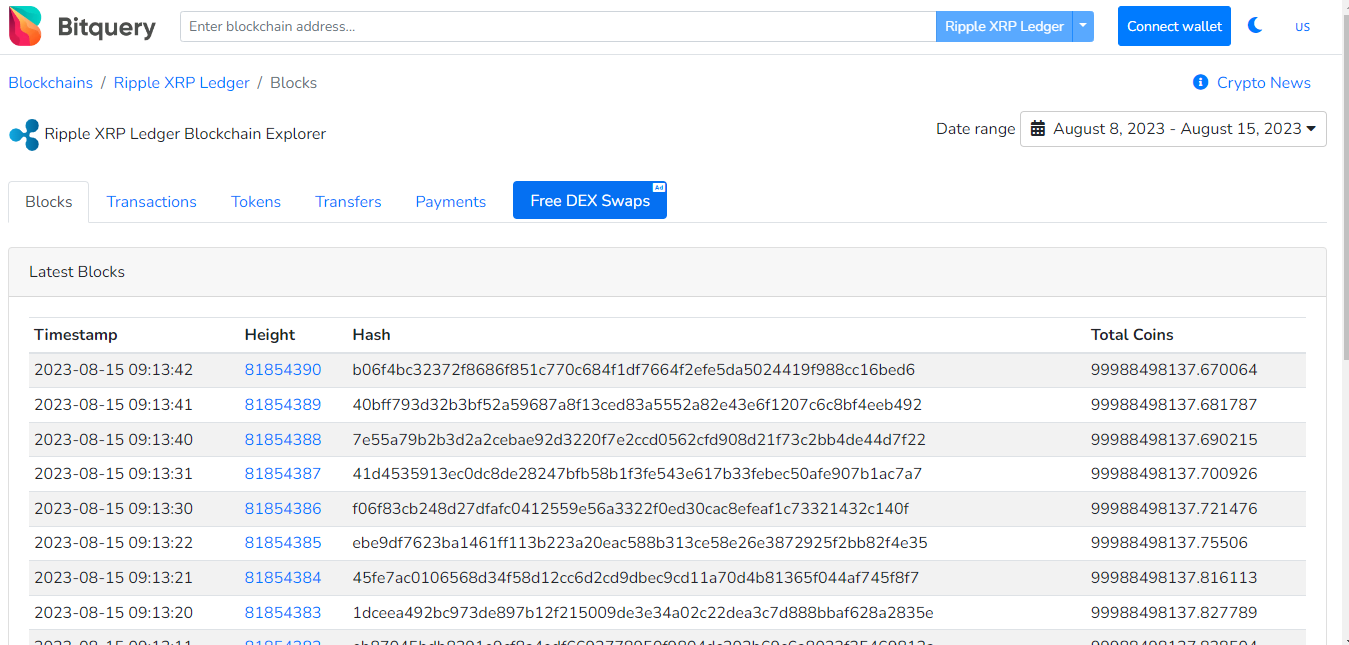
To retrieve data from the Ripple blockchain, you need to use the API as shown below:
query{
  ripple{
    __typename
  }
}
info
Sign up on our GraphQL IDE and get your Access Token, Read our guide on getting started.
The XRP Ledger (often called Ripple in market contexts) is payment-centric: XRP pays transaction fees and serves as a bridge asset, while the protocol includes a built-in DEX, escrows, checks, payment channels, and NFTokens for richer settlement patterns than simple one-hop sends. Bitquery exposes blocks (ledgers), transactions, transfers, payments, balances, offers, and coinpath for both XRP and issued assets.
What You Can Query
- Blocks — ledger indexes, close times, and consensus-advanced ledger boundaries
- Transactions — types, outcomes, fees in XRP, and metadata for each validated transaction
- Payments — path payments, partial payments, and cross-currency settlement fields where the schema models them
- Transfers — XRP and issued-currency movements between accounts
- Balances — trust-line and reserve-related views as exposed for addresses and assets
- Offers — limit orders and liquidity on the ledger’s native decentralized exchange
- Coinpath — aggregated flows across intermediate steps for complex payment paths
Common Use Cases
- Remittance and payments — analyze high-volume payment traffic and bridge use of XRP between corridors
- DEX and liquidity — monitor offers, fills, and trading-related transactions on the built-in order book
- Advanced ledger features — study escrows, checks, payment channels, or NFTokens when querying those transaction families
- Banking and institutional settlement — financial institutions using XRP as a bridge asset or RippleNet corridors can reconcile ledger-level payment flows, escrow releases, and trust-line positions for treasury and regulatory reporting
- Enterprise escrow and payment channel management — businesses leveraging on-ledger escrows or payment channels for scheduled disbursements or streaming payments can track state changes and settlement outcomes programmatically