Polygon (MATIC) DEX Trades API
The Trading API is the fastest path to clean Polygon market data. Trading.Trades returns MEV-filtered swaps with USD price, market cap and supply on every row, across 10 chains in one API — filter with Pair.Market.Network: Matic. Pre-aggregated OHLC down to one second comes from Trading.Tokens and Trading.Pairs, so you never have to build candles yourself.
Reach for the chain-level queries on this page when you need something the Trading API deliberately does not carry: history older than the Trading window (via dataset: combined or archive), raw per-swap detail, pool internals, or call and event context. Both are shown below, starting with the Trading API.
Polygon (formerly Matic) settles DEX activity across Uniswap v2/v3, QuickSwap, Balancer, SushiSwap and the Polymarket CTF exchange. This page shows how to query and stream that activity with the Bitquery GraphQL API: live swap streams, real-time and historical token prices, OHLC candles, top tokens and traders, and full trade history through the archive dataset.
Polygon's native asset was rebranded from MATIC to POL, so the wrapped native token reports as WPOL (contract 0x0d500b1d8e8ef31e21c99d1db9a6444d3adf1270 — unchanged from WMATIC). Bridged Tether reports as USDT0 at 0xc2132d05d31c914a87c6611c10748aeb04b58e8f. Filter by contract address rather than symbol wherever you can — addresses are stable across rebrands.
Live DEX swap stream (Polygon)
Crypto Trades API: one row per swap, with USD and supply. For Polygon use Pair.Market.Network: Matic. When to use this vs chain DEX APIs.
Run this subscription in the Bitquery IDE.
Click to expand GraphQL query
subscription {
  Trading {
    Trades(where: { Pair: { Market: { Network: { is: "Matic" } } } }) {
      Side
      Supply {
        MaxSupply
        TotalSupply
        FullyDilutedValuationUsd
        CirculatingSupply
        MarketCap
      }
      Trader {
        Address
      }
      TransactionHeader {
        Fee
        FeePayer
        Sender
        To
        Hash
        Index
      }
      Amounts {
        Base
        Quote
      }
      AmountsInUsd {
        Base
        Quote
      }
      Block {
        Date
        Time
        Timestamp
      }
      Pair {
        Currency {
          Id
          Name
          Symbol
        }
        Market {
          Address
          Program
          Network
        }
        QuoteCurrency {
          Id
          Name
          Symbol
        }
        Token {
          Address
          Id
          IsNative
          Symbol
          TokenId
          Network
        }
        QuoteToken {
          Address
          Id
          IsNative
          Symbol
          TokenId
          Network
        }
      }
      Price
      PriceInUsd
    }
  }
}
OHLC candles for a Polygon token
If you are building a chart, do not aggregate raw swaps yourself. Trading.Tokens returns ready-made candles: set Interval.Time.Duration to the candle width in seconds (60, 300, 3600, 86400) and filter the token by address.
This example returns five-minute candles for WPOL over the last three hours, with volume in both base units and USD.
{
  Trading {
    Tokens(
      limit: { count: 36 }
      orderBy: { descending: Block_Time }
      where: {
        Token: {
          Network: { is: "Matic" }
          Address: { is: "0x0d500b1d8e8ef31e21c99d1db9a6444d3adf1270" }
        }
        Interval: { Time: { Duration: { eq: 300 } } }
        Block: { Time: { since_relative: { hours_ago: 3 } } }
      }
    ) {
      Interval {
        Time {
          Start
          End
          Duration
        }
      }
      Token {
        Symbol
        Address
        Network
      }
      Currency {
        Symbol
      }
      Price {
        Ohlc {
          Open
          High
          Low
          Close
        }
      }
      Volume {
        Base
        Usd
      }
    }
  }
}
Swap Duration for the candle size you need, and drop the Block.Time filter to walk further back. For pair-level candles — one specific pool rather than the token's aggregated price — use Trading.Pairs with a Market.Address filter.
Historical Polygon trades (archive dataset)
The realtime dataset covers a rolling recent window. For anything older, add dataset: archive (history only) or dataset: combined (history plus realtime) to the EVM selector. This is the main reason to use chain-level DEXTrades instead of the Trading API.
The query below pulls Polygon swaps from a fixed historical day. Change the since / till bounds to any range you need.
{
  EVM(network: matic, dataset: archive) {
    DEXTrades(
      limit: { count: 25 }
      orderBy: { descending: Block_Time }
      where: {
        Block: {
          Time: { since: "2025-01-01T00:00:00Z", till: "2025-01-02T00:00:00Z" }
        }
      }
    ) {
      Block {
        Time
        Number
      }
      Transaction {
        Hash
        From
      }
      Trade {
        Dex {
          ProtocolName
          ProtocolFamily
          SmartContract
        }
        Buy {
          Amount
          Currency {
            Symbol
            SmartContract
          }
          PriceInUSD
          Buyer
        }
        Sell {
          Amount
          Currency {
            Symbol
            SmartContract
          }
        }
      }
    }
  }
}
PriceInUSD is derived from the trade itself, so it can come back as 0 or wildly off for pools with almost no liquidity. If you need dependable USD, use the Trading API (which carries a vetted price per row) or filter on PriceAsymmetry as shown below.
Latest Polygon DEX trades
This example uses the chain-specific DEXTrades cube via EVM(network: matic) { DEXTrades } (pool-side Buy/Sell; see DEXTrades cube). For trader-oriented rows with reliable USD, use the stream at the top.
Read DEXTrades vs DEXTradeByTokens vs Trades cube to understand when to use which cube. You can find the query here
subscription {
  EVM(network: matic) {
    DEXTrades {
      Block {
        Time
      }
      Trade {
        Dex {
          ProtocolName
          ProtocolFamily
          SmartContract
        }
        Buy {
          Amount
          Buyer
          Seller
          Currency {
            Decimals
            Fungible
            HasURI
            Name
            ProtocolName
            SmartContract
            Symbol
          }
          OrderId
        }
        Sell {
          Buyer
          Seller
          Currency {
            Decimals
            Fungible
            HasURI
            Name
            ProtocolName
            SmartContract
            Symbol
          }
        }
      }
    }
  }
}
Real-time price of a token in terms of another
This subscription streams the price of WPOL in terms of USDC, including the DEX, market and order details. Filtering both sides pins you to a single trading direction on a specific pair.
subscription {
  EVM(network: matic) {
    DEXTrades(
      where: {
        Trade: {
          Sell: {
            Currency: {
              SmartContract: {
                is: "0x0d500b1d8e8ef31e21c99d1db9a6444d3adf1270"
              }
            }
          }
          Buy: {
            Currency: {
              SmartContract: {
                is: "0x3c499c542cef5e3811e1192ce70d8cc03d5c3359"
              }
            }
          }
        }
      }
    ) {
      Block {
        Time
      }
      Trade {
        Buy {
          Amount
          Buyer
          Seller
          Price_in_terms_of_sell_currency: Price
          Currency {
            Name
            Symbol
            SmartContract
          }
          OrderId
        }
        Sell {
          Amount
          Buyer
          Seller
          Price_in_terms_of_buy_currency: Price
          Currency {
            Symbol
            SmartContract
            Name
          }
          OrderId
        }
        Dex {
          ProtocolFamily
          ProtocolName
          SmartContract
          ProtocolVersion
        }
      }
    }
  }
}
To watch one pool rather than every pool for the pair, add a
Trade: { Dex: { SmartContract: { is: "0x..." } } } filter.
Latest USD price of a token
This subscription returns the USD price of a token by filtering on the buy-side contract — here WETH on Polygon. Read PriceInUSD for the USD value. PriceAsymmetry(selectWhere: {lt: 1}) drops trades whose two legs disagree badly on value, which is the cheapest way to filter out bot noise and broken pools.
subscription {
  EVM(network: matic) {
    DEXTrades(
      where: {
        Trade: {
          Buy: {
            Currency: {
              SmartContract: {
                is: "0x7ceb23fd6bc0add59e62ac25578270cff1b9f619"
              }
            }
          }
        }
      }
    ) {
      Block {
        Number
        Time
      }
      Transaction {
        From
        To
        Hash
      }
      Trade {
        Buy {
          Amount
          Buyer
          Currency {
            Name
            Symbol
            SmartContract
          }
          Seller
          Price
          PriceInUSD
        }
        Sell {
          Amount
          Buyer
          Currency {
            Name
            SmartContract
            Symbol
          }
          Seller
          Price
        }
        PriceAsymmetry(selectWhere: { lt: 1 })
      }
    }
  }
}
Top tokens on Polygon by traded volume
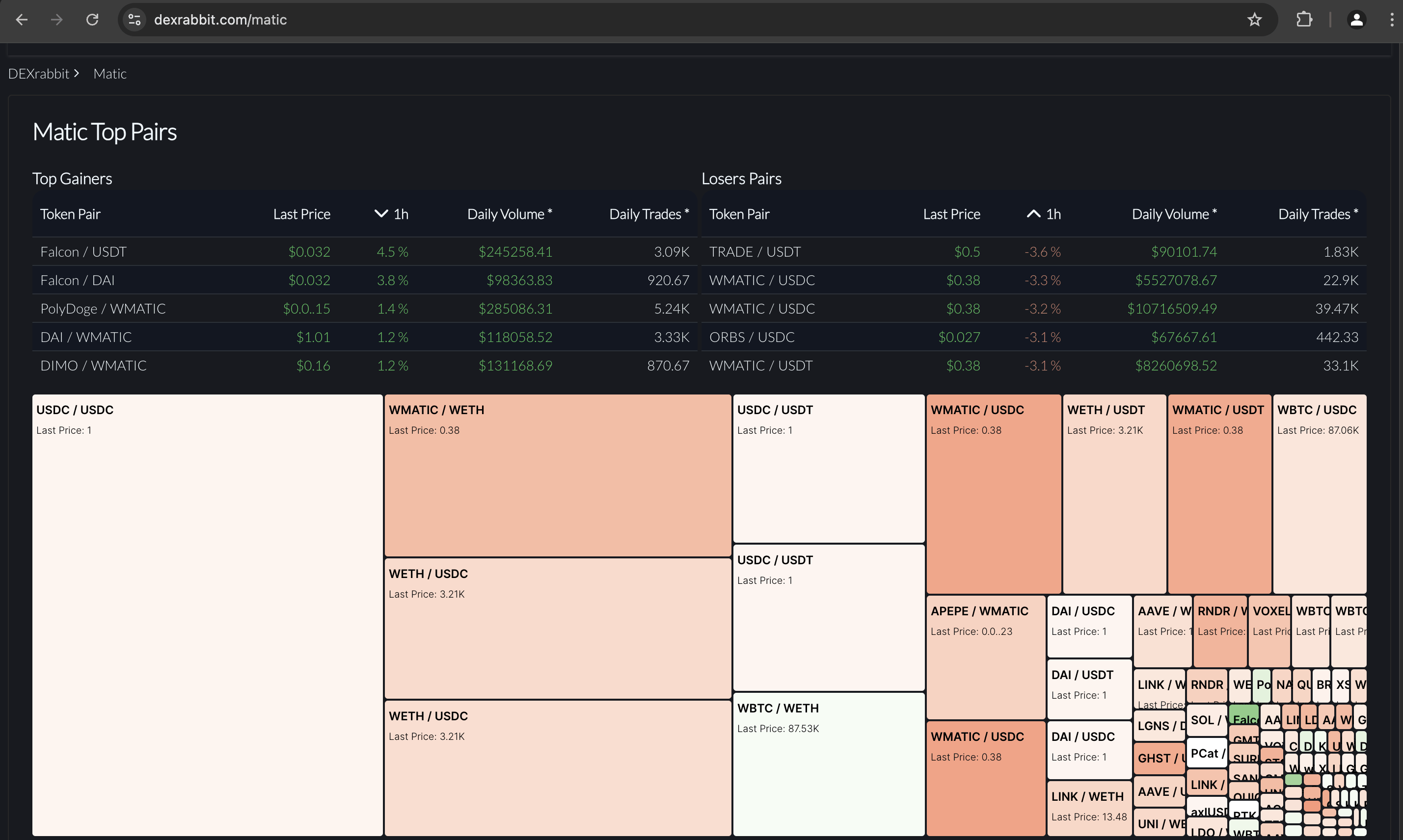
This query ranks Polygon tokens by USD volume over a relative window and returns the price now versus the start of the window, so you can compute a change percentage client-side.
Two filters matter more than they look:
Currency: { Fungible: true }— without it, results are dominated by Polymarket's ERC-1155 outcome tokens, which trade in enormous quantities on Polygon, carry empty symbols, and are almost certainly not what you are ranking. See the Polymarket API if they are what you want.SmartContract: { notIn: $quotes }on the trade side andin: $quoteson the counter-side — this keeps stablecoins and wrapped majors as quote assets instead of letting them top their own leaderboard.
Using since_relative rather than fixed timestamps means the query stays correct whenever it is run.
query topTokens($network: evm_network, $quotes: [String!], $min_usd: String) {
  EVM(network: $network) {
    DEXTradeByTokens(
      where: {
        Block: { Time: { since_relative: { hours_ago: 24 } } }
        Trade: {
          Currency: { Fungible: true, SmartContract: { notIn: $quotes } }
          Side: { Currency: { SmartContract: { in: $quotes } } }
        }
      }
      orderBy: { descendingByField: "usd" }
      limit: { count: 25 }
    ) {
      Trade {
        Currency {
          Symbol
          Name
          SmartContract
        }
        price_now: PriceInUSD(maximum: Block_Number)
        price_window_start: PriceInUSD(minimum: Block_Number)
      }
      usd: sum(of: Trade_Side_AmountInUSD, selectWhere: { ge: $min_usd })
      trades: count
      buyers: uniq(of: Trade_Buyer)
      sellers: uniq(of: Trade_Seller)
      dexes: uniq(of: Trade_Dex_OwnerAddress)
    }
  }
}
Variables — the quote list is native USDC, bridged USDC.e, USDT0, DAI, WETH, WPOL and WBTC:
{
  "network": "matic",
  "quotes": [
    "0x3c499c542cef5e3811e1192ce70d8cc03d5c3359",
    "0x2791bca1f2de4661ed88a30c99a7a9449aa84174",
    "0xc2132d05d31c914a87c6611c10748aeb04b58e8f",
    "0x8f3cf7ad23cd3cadbd9735aff958023239c6a063",
    "0x7ceb23fd6bc0add59e62ac25578270cff1b9f619",
    "0x0d500b1d8e8ef31e21c99d1db9a6444d3adf1270",
    "0x1bfd67037b42cf73acf2047067bd4f2c47d9bfd6"
  ],
  "min_usd": "25000"
}
A heatmap built on this shape of query is live at dexrabbit.bitquery.io/matic.
Top traders of a token
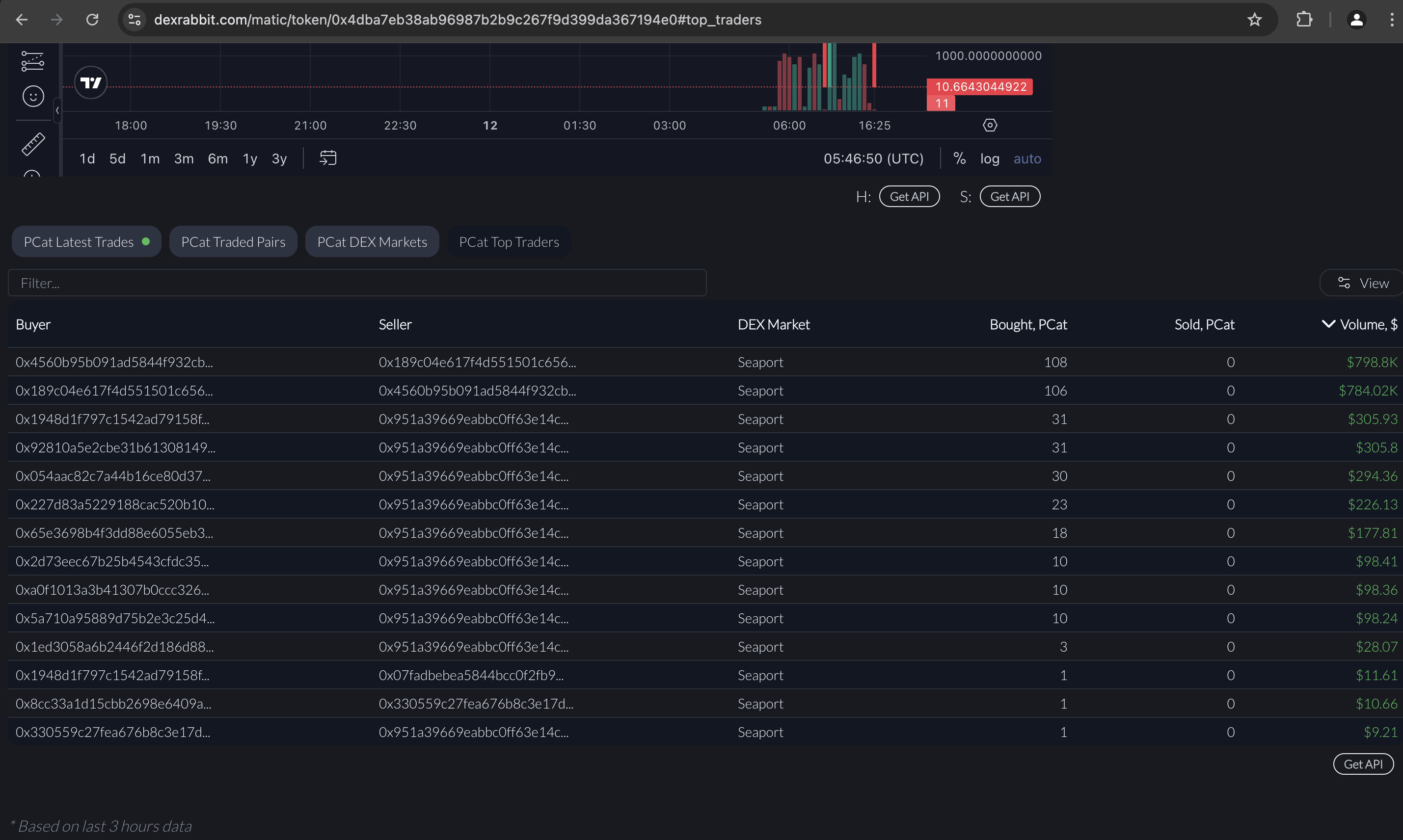
This query ranks traders of one token by volume, splitting bought and sold amounts and totalling volume in native and USD terms. since_relative keeps the window rolling.
You can run the query here
query topTraders($network: evm_network, $token: String) {
  EVM(network: $network) {
    DEXTradeByTokens(
      orderBy: { descendingByField: "volumeUsd" }
      limit: { count: 100 }
      where: {
        Trade: { Currency: { SmartContract: { is: $token } } }
        Block: { Time: { since_relative: { days_ago: 3 } } }
      }
    ) {
      Trade {
        Buyer
        Dex {
          ProtocolFamily
        }
      }
      bought: sum(of: Trade_Amount, if: { Trade: { Side: { Type: { is: buy } } } })
      sold: sum(of: Trade_Amount, if: { Trade: { Side: { Type: { is: sell } } } })
      volume: sum(of: Trade_Amount)
      volumeUsd: sum(of: Trade_Side_AmountInUSD)
    }
  }
}
{
  "network": "matic",
  "token": "0x0d500b1d8e8ef31e21c99d1db9a6444d3adf1270"
}
This query is available as a chart and table on dexrabbit.bitquery.io/matic.
More examples
Top Traders by PnL for a Specific Pool (Last 30 Minutes)
Rank traders by PnL on one pool: filter Pair.Market.Address, last 30 minutes, limit: 10, and orderBy PnL descending. Useful for leaderboards, smart-money screens, and pool-specific trader analytics.
You can run this query in the Bitquery IDE.
Click to expand GraphQL query
{
  Trading {
    Trades(
      limit: { count: 10 }
      orderBy: { descendingByField: "PnL" }
      where: {
        Block: { Time: { since_relative: { minutes_ago: 30 } } }
        Pair: {
          Market: {
            Address: { is: "0x5757371414417b8c6caad45baef941abc7d3ab32" }
          }
        }
      }
    ) {
      Trader {
        Address
      }
      Amount_Bought: sum(of: AmountsInUsd_Base, if: { Side: { is: "Buy" } })
      Amount_Sold: sum(of: AmountsInUsd_Base, if: { Side: { is: "Sell" } })
      Amount_Bought_native: sum(of: Amounts_Base, if: { Side: { is: "Buy" } })
      Amount_Sold_native: sum(of: Amounts_Base, if: { Side: { is: "Sell" } })
      PnL: calculate(expression: "$Amount_Sold - $Amount_Bought")
      buys: count(if: { Side: { is: "Buy" } })
      sells: count(if: { Side: { is: "Sell" } })
    }
  }
}
Related Polygon APIs
- Polygon (MATIC) Address Balance API — token and native balances
- Polygon (MATIC) Transfers API — ERC-20 and native transfers
- Polymarket API — prediction market trades and outcome prices on Polygon
- Trading API overview — structured trades, prices and OHLC across 10 chains
Ready to run this in production?
Get an API key and run these queries in minutes, or talk to us about plans and enterprise delivery.