Reconnect Automatically After Disconnect
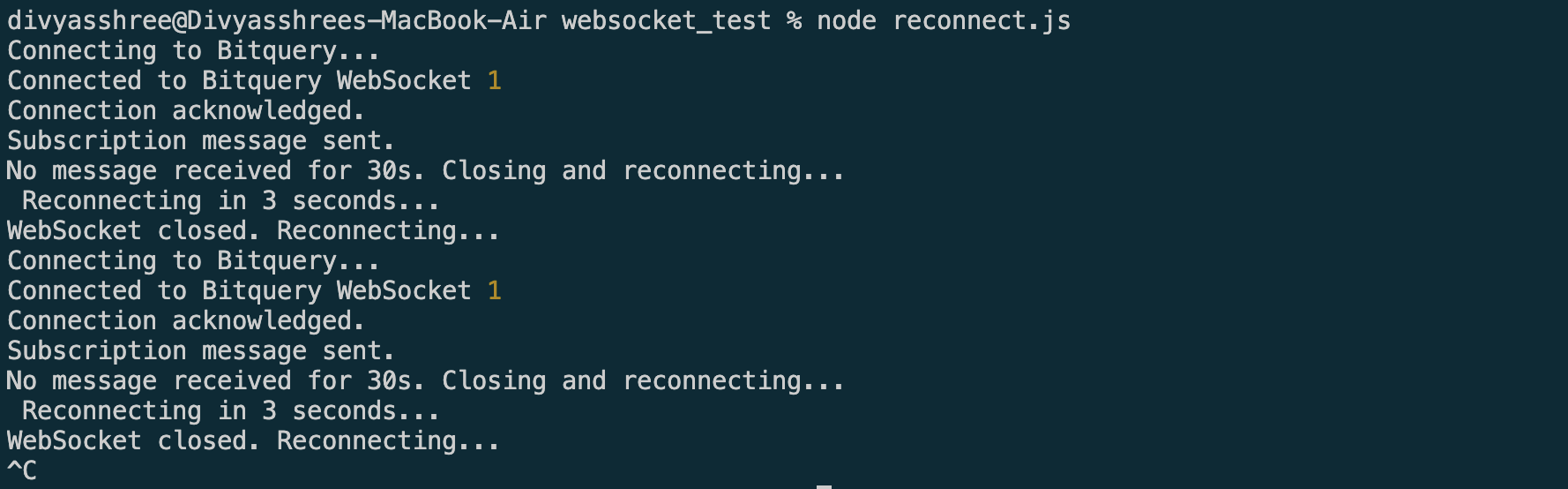
When using Bitquery GraphQL streams via WebSocket, you need to implement reconnect logic if you don't receive any data or a 'ka' message for, say, 10 seconds. Bitquery's WebSocket server doesn’t allow mid-connection retries or re-inits, so once "ka" or data stops, you must fully close and re-establish the WebSocket connection
This is how it would look with below sample implemention of a silent disconnect-reconnect scenario.
Best Practices
When implementing WebSocket subscriptions with auto-reconnect, follow these best practices:
-
Separate Processing and Consumption: Keep message processing and consumption as separate, non-blocking processes. Processing incoming data should not block the WebSocket connection from receiving new messages. Use asynchronous handlers, queues, or separate threads/workers to process data independently from the WebSocket receiver.
-
Use Standard WebSocket Libraries: Instead of manually managing each step of the WebSocket lifecycle (connection, subscription, keep-alive, reconnection), use well-tested WebSocket libraries that handle the full subscription lifecycle automatically. Libraries like
graphql-ws,apollo-client, or similar provide built-in reconnection logic, subscription management, and error handling, reducing the complexity and potential bugs in your implementation.
Close code 1013: consuming too slowly
Not every disconnect is silent. If your client falls behind the stream, the server closes the socket with an explicit reason:
close code 1013 — client is not consuming messages fast enough
1013 is "Try Again Later" in the WebSocket spec. The query is fine and the connection was
fine; the server is shedding a consumer that stopped keeping up.
Reconnecting alone will not fix this, because the new connection falls behind the same way. Two changes do:
- Narrow the subscription. High-volume cubes such as
Solana.InstructionsandSolana.BalanceUpdatescarry every instruction and balance change on the chain. Add awherefilter for the program, token or account you actually care about. The same subscription that gets dropped unfiltered runs cleanly when scoped to one token. - Never process inside the read loop (best practice 1 above). Push each message to a queue and handle it in a separate worker, so a slow parse or database write cannot stall the socket.
This failure is load-dependent, so an unfiltered subscription often works in development and drops in production. See which cubes support subscriptions for the cubes that require a filter and the ones that never push data at all.
Sample Implementation in JavaScript
const { WebSocket } = require("ws");
let isReconnecting = false;

let bitqueryConnection;
let lastMessageTime = Date.now();
const INACTIVITY_TIMEOUT_MS = 5000;
let inactivityInterval;
const GRAPHQL_SUBSCRIPTION_ID = "1";

const subscriptionQuery = `
  subscription {
    Tron(mempool: true) {
      Transfers {
        Transfer {
          Sender
          Receiver
          Amount
          AmountInUSD
          Currency {
            Symbol
          }
        }
      }
    }
  }
`;

function connectToBitquery() {
  console.log("Connecting to Bitquery...");
  const wsUrl = `wss://streaming.bitquery.io/graphql?token=ory_`;
  bitqueryConnection = new WebSocket(wsUrl, ["graphql-ws"]);

  bitqueryConnection.on("open", () => {
    console.log(
      "Connected to Bitquery WebSocket",
      bitqueryConnection.readyState
    );

    // Send connection_init ONLY after socket is open
    bitqueryConnection.send(JSON.stringify({ type: "connection_init" }));

    lastMessageTime = Date.now();
    startInactivityTimer();
  });

  bitqueryConnection.on("message", (data) => {
    lastMessageTime = Date.now();

    let response;
    try {
      response = JSON.parse(data);
    } catch (err) {
      console.error("Invalid JSON from server:", data);
      return;
    }

    switch (response.type) {
      case "connection_ack":
        console.log("Connection acknowledged.");

        // Send subscription only now (socket is open + server ack)
        sendSubscription();
        break;

      case "data":
        console.log("Received data");

        // Push to queue for async processing
        //  setImmediate(() => processData(response.payload.data));

        // console.log(response.payload.data.Tron.Transfers.Transfer)
        break;

      case "ka":
        console.log("Keep-alive received.");
        break;

      case "error":
        console.error("Error from server:", response.payload.errors);
        break;

      default:
        console.warn("Unknown message type:", response);
    }
  });

  bitqueryConnection.on("close", () => {
    console.warn("WebSocket closed. Reconnecting...");
    reconnect();
  });

  bitqueryConnection.on("error", (error) => {
    console.error("WebSocket error:", error.message);
    reconnect();
  });
}

function sendSubscription() {
  if (bitqueryConnection.readyState !== WebSocket.OPEN) {
    console.warn("Cannot send subscription, socket not open.");
    return;
  }

  const subscriptionMessage = {
    type: "start",
    id: GRAPHQL_SUBSCRIPTION_ID,
    payload: { query: subscriptionQuery },
  };

  bitqueryConnection.send(JSON.stringify(subscriptionMessage));
  console.log("Subscription message sent.");
}

function startInactivityTimer() {
  clearInterval(inactivityInterval);
  inactivityInterval = setInterval(() => {
    if (Date.now() - lastMessageTime > INACTIVITY_TIMEOUT_MS) {
      console.warn("No message received for 5s. Closing and reconnecting...");
      reconnect();
    }
  }, 5000);
}

function reconnect() {
  if (isReconnecting) return; // Prevent multiple calls
  isReconnecting = true;

  clearInterval(inactivityInterval);

  if (bitqueryConnection) {
    try {
      // Send complete message to properly terminate subscription before closing
      if (bitqueryConnection.readyState === WebSocket.OPEN) {
        const completeMessage = {
          type: "complete",
          id: GRAPHQL_SUBSCRIPTION_ID,
        };
        bitqueryConnection.send(JSON.stringify(completeMessage));
        console.log("Complete message sent before reconnection.");
      }
      bitqueryConnection.close(1000, "Reconnecting due to inactivity");
    } catch (e) {
      console.error("Error closing connection:", e.message);
    }
  }

  console.warn(" Reconnecting in 3 seconds...");
  setTimeout(() => {
    isReconnecting = false;
    connectToBitquery();
  }, 3000); // wait before retrying
}

connectToBitquery();
Consider implementing an exponential backoff logic (e.g., retry at 3s, 6s, 12s, up to a max) to avoid sending repeated subscription requests.
Ready to run this in production?
Get an API key and run these queries in minutes, or talk to us about plans and enterprise delivery.